Does the Medicube NAD+ serum have any actual evidence behind it?
Some, but not for the reason the name suggests. NAD+ and EGF are in there at tiny amounts and the evidence for NAD+ in a serum is thin, while niacinamide, listed fourth, is the ingredient with real research behind it.
· by Aerely Chacón
A lot of you have told me in my comments that the Medicube NAD serum is a scam and that there is no evidence behind it. Some of you were rude about it, and honestly, the question underneath is fair. So I went and read the ingredient list and the studies instead of just telling you I love it.
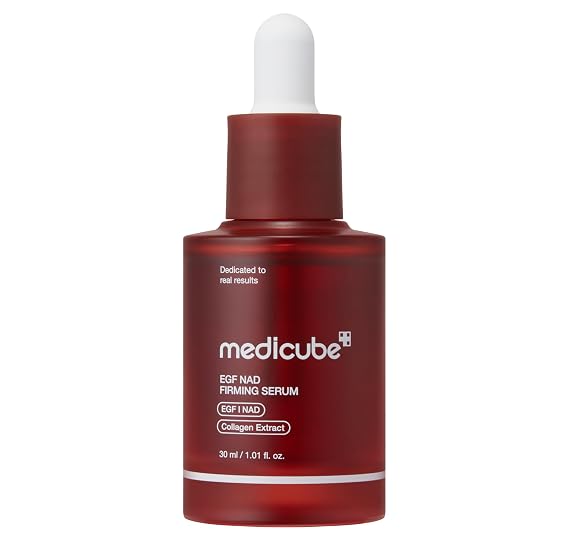
EGF NAD+ Firming Serum
Two drops pressed into smile lines, nightly once your skin is used to it. Weeks, not days.
Quick disclosure before anything else: I work with Medicube, so I get paid when you buy through my links. That is exactly why I want this post to be the boring, honest version and not the hype version.
How much NAD+ and EGF is actually in it?
This is the part that surprised me. Medicube prints the amounts right in the ingredient list. NAD+ is listed at 1 ppm and EGF (sh-oligopeptide-1) at 2.5 ppm. ppm means parts per million, so we are talking about a tiny fraction of a percent. That is normal for these two ingredients, they are expensive and fragile, but it means the names on the front of the bottle are not the main thing in the bottle.
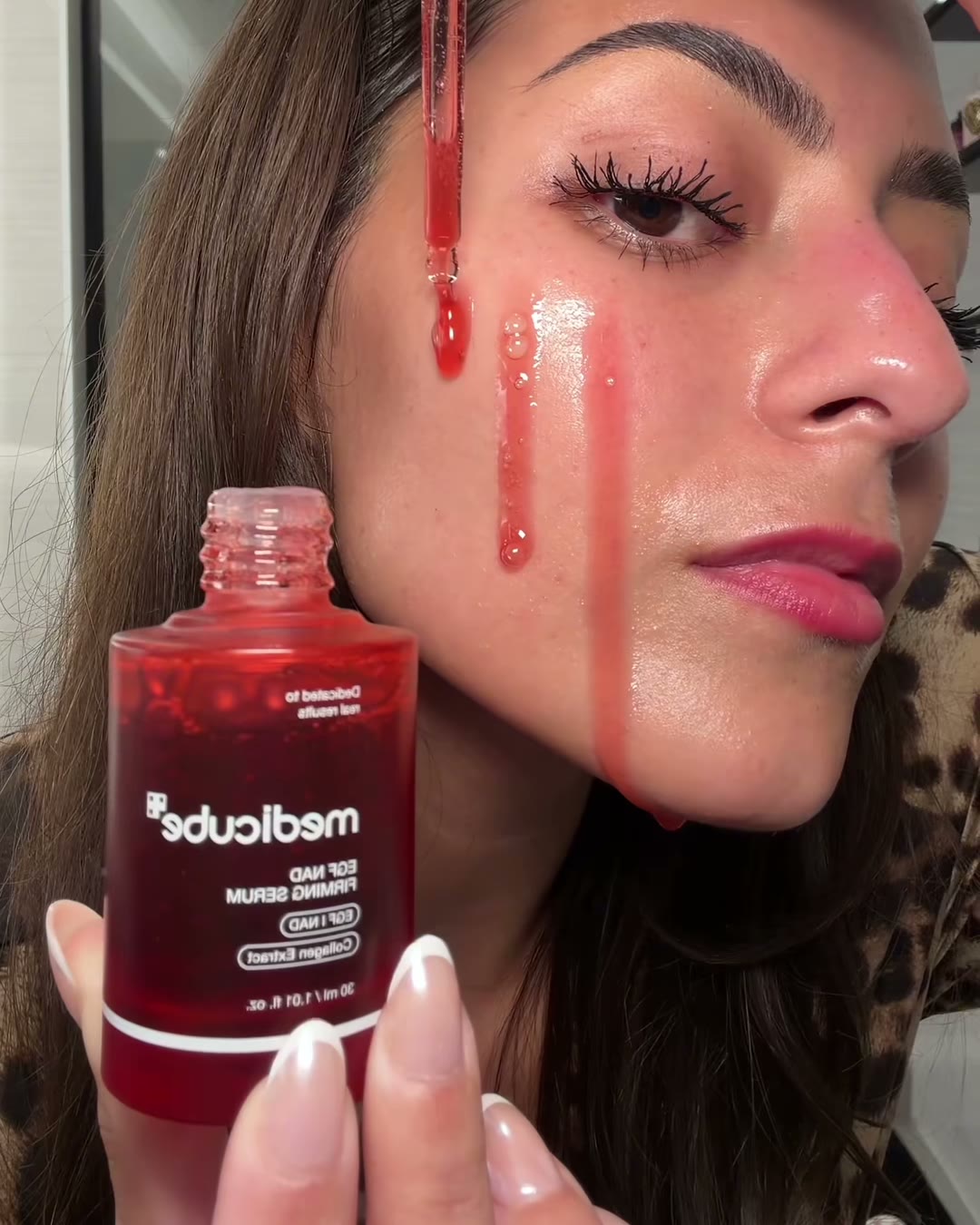
What is high up in the list is niacinamide, listed fourth. And niacinamide is the ingredient in here with the most real research behind it.
What do the studies say about NAD+ on skin?
Honest answer: not much yet for NAD+ itself in a serum. NAD+ is a coenzyme your cells use to make energy, and levels drop as skin ages, which is why the idea is exciting. But the research mostly looks at precursors, the ingredients your skin turns into NAD+, and niacinamide is one of them. Topical niacinamide has years of clinical trials showing it can help with the look of fine lines, uneven tone and a weak barrier. NAD+ applied straight from a bottle at 1 ppm does not have that kind of track record. If someone tells you it does, ask them for the study.
And EGF, does that have evidence?
More than NAD+, less than the marketing implies. There are small trials where EGF serums used for about three months improved the look of texture, pores and fine lines, and a 2023 review in the International Wound Journal sums up that work. But a 2024 randomized pilot that compared two EGF serums for 12 weeks found that overall wrinkle severity barely changed in either group, even though texture and firmness scored better. So the realistic version is texture and smoothness, slowly, not wrinkles disappearing.
Does Medicube have its own clinical results?
They do, and I want you to read them the right way. Medicube says the serum was clinically tested by the Global Institute of Dermatological Sciences and lists an 8.7 percent reduction in the look of smile lines and 5.38 percent on neck lines. Those are brand-run tests, the page does not say how many people were in it, and 8.7 percent is a modest change, not a transformation. It is something. It is not proof that the NAD+ part is doing the work.
So why do I still use it?
Because my skin looks smoother and more even when I stay consistent with it, and I like how it feels. If I am being real, I think the niacinamide and the hydration are doing a lot of that, and the NAD+ and EGF are the exciting names on the label. That is fine with me, as long as I am not pretending otherwise.
Who this is not for
If you want something with strong published evidence for fine lines, a plain niacinamide serum or a retinoid is the better buy, and I will tell you that even though I am paid by Medicube. If you have very sensitive or reactive skin, patch test first. If you have deep lines or real volume loss, no serum changes that, that is a conversation for a dermatologist. And if you want results in a week, skip it, this is a weeks-and-consistency product at best.
Use it because you like it and your skin likes it. Not because the bottle says NAD+.
Products in this post
EGF NAD+ Firming Serum
Two drops pressed into smile lines, nightly once your skin is used to it. Weeks, not days.
Questions I get about this
How much NAD+ is in the Medicube EGF NAD+ Firming Serum?
Medicube lists NAD+ at 1 ppm and EGF (sh-oligopeptide-1) at 2.5 ppm in the ingredient list, a tiny fraction of a percent. Niacinamide is listed fourth, so it is present in a much larger amount.
Is there scientific evidence that topical NAD+ works?
Not much yet for NAD+ itself in a serum. Most of the research is on precursors like niacinamide, which has years of clinical trials for the look of fine lines, tone and barrier. Direct evidence for NAD+ applied from a bottle is limited.
Are Medicube's clinical results independent?
They are brand-run. Medicube cites testing by the Global Institute of Dermatological Sciences showing an 8.7 percent reduction in the look of smile lines, but the product page does not give the number of participants. Treat it as a modest result, not proof.
Watch the original: TikTok